

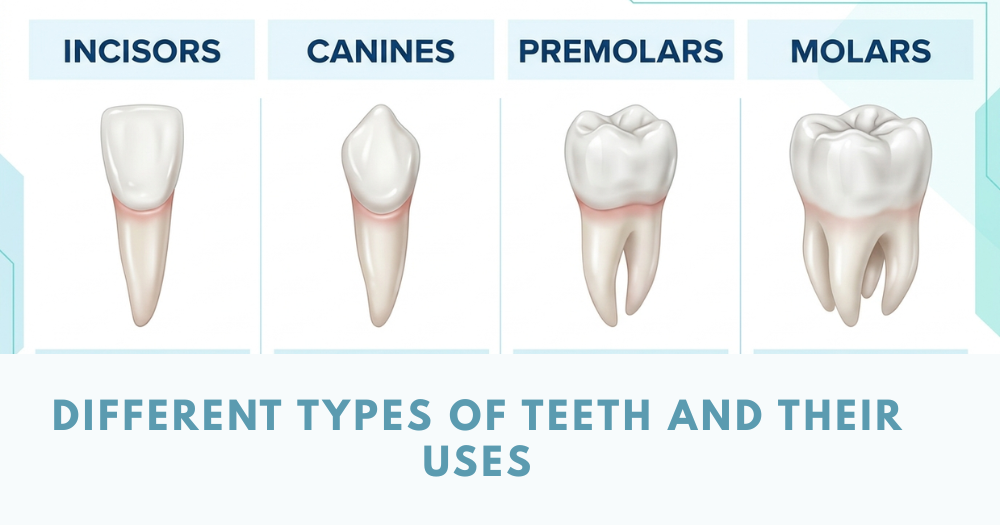
Have you ever wondered why your teeth have different shapes and sizes? Each tooth in your mouth has a specific job. Some teeth help you bite into food, while others tear, crush, and grind it so that it is easier to swallow and digest.
The four main types of permanent human teeth are incisors, canines, premolars, and molars. Together, they help you chew food, speak clearly, and maintain the natural shape of your face.
Understanding the different types of teeth can help you appreciate their functions and learn how to care for your oral health.
What Are the Four Types of Teeth?
Adults typically have four types of teeth, each designed to perform a particular function.
1. Incisors: Teeth Used for Biting
Incisors are the front teeth located in the upper and lower jaws. They have relatively thin, sharp edges that help you bite and cut food into smaller pieces.
For example, when you bite into an apple or a sandwich, your incisors do most of the initial cutting.
How many incisors do adults have?
Adults typically have eight incisors: four in the upper jaw and four in the lower jaw.
Keeping these teeth healthy is important because they are highly visible when you smile and play an important role in speech.
2. Canines: Teeth Used for Tearing
Canines are the pointed teeth located beside the incisors. They are also known as cuspids or eye teeth.
Their pointed shape helps grip and tear food, particularly when eating foods that require more force to separate.
Canines also help guide the movement of the jaw during certain biting movements. Their long roots provide support and help maintain the natural structure of the dental arch.
How many canines do adults have?
Adults normally have four canines: two in the upper jaw and two in the lower jaw.
Because canines are important for biting and guiding jaw movement, a dentist may assess their position and health during routine dental examinations.
3. Premolars: Teeth Used for Crushing
Premolars, also called bicuspids, are located between the canines and molars. They have broader surfaces than the front teeth and usually feature two or more raised points called cusps.
Their main function is to crush and break food into smaller pieces before it is ground further by the molars.
How many premolars do adults have?
Adults typically have eight premolars: four in the upper jaw and four in the lower jaw.
Unlike permanent teeth, primary or baby teeth do not include premolars. When children grow, their permanent premolars replace their baby molars.
4. Molars: Teeth Used for Grinding
Molars are the large teeth located at the back of the mouth. They have wide chewing surfaces designed to grind food into smaller particles.
They play an important role when chewing foods such as vegetables, grains, nuts, and other firm foods.
How many molars do adults have?
Adults can have up to 12 molars, including four wisdom teeth. This means they typically have eight first and second molars, plus up to four third molars.
Wisdom teeth do not develop fully or emerge in every person. Some remain impacted beneath the gums, while others may be removed if they cause problems.
Because molars have grooves and pits on their chewing surfaces, food particles and plaque can accumulate in these areas. Brushing carefully and maintaining regular dental check-ups can help reduce the risk of cavities.
How Many Teeth Do Adults Have?
A complete adult set usually contains 32 permanent teeth, including wisdom teeth.
| Type of tooth | Number in adults | Main function |
|---|---|---|
| Incisors | 8 | Biting and cutting |
| Canines | 4 | Gripping and tearing |
| Premolars | 8 | Crushing food |
| Molars | 12 | Grinding food |
| Total | 32 | Chewing and biting |
Some adults have fewer than 32 teeth because their wisdom teeth never develop, don’t erupt, or are removed. Fewer teeth does not automatically mean someone has poor oral health.
What Are the Four Types of Teeth in Children?
Children generally develop 20 primary teeth, commonly called baby teeth. These include incisors, canines, and molars, but no premolars.
The typical breakdown is:
- 8 incisors
- 4 canines
- 8 molars
Baby teeth help children bite and chew food, develop speech, and maintain space for their future permanent teeth. As children grow, permanent teeth gradually replace the primary teeth. The first permanent molars usually erupt behind the baby molars rather than replacing them. Permanent premolars later replace the primary molars.
Parents should continue to supervise children’s brushing and routine dental visits to help identify cavities, eruption problems, and other concerns early.
Why Are the Four Types of Teeth Important?
Each type of tooth contributes to healthy oral function.
- Eating: Different tooth shapes help cut, tear, crush, and grind food.
- Speech: Teeth work with the tongue and lips to produce certain sounds.
- Appearance: Healthy teeth support the natural shape of your smile and lower face.
- Bite function: Properly positioned teeth help distribute chewing forces.
- Oral health: Maintaining all healthy teeth helps preserve comfortable chewing and the balance of your bite.
If a tooth becomes damaged, painful, loose, or difficult to use, a dental examination can help identify the cause and determine the appropriate treatment.
How Can You Keep All Four Types of Teeth Healthy?
Good oral hygiene helps protect the front and back teeth throughout life.
Brush twice a day: Use fluoride toothpaste and a soft-bristled toothbrush. Pay attention to the back molars, where plaque can accumulate.
Clean between your teeth: Use dental floss or an appropriate interdental cleaner to remove plaque from areas your toothbrush cannot reach easily.
Limit frequent sugary snacks and drinks: Repeated sugar exposure increases the risk of tooth decay.
Drink water regularly: Water helps rinse away food particles and supports normal saliva function.
Avoid using your teeth as tools: Do not use your teeth to open packaging or bite hard objects, as this can cause chips and cracks.
Visit your dentist regularly: Routine examinations can help identify cavities, gum problems, and changes in your bite before they become more serious.
For children, preventive care is particularly important as baby teeth are replaced by permanent teeth.
Faq
1. What are the four types of teeth?
The four main types of permanent human teeth are incisors, canines, premolars, and molars. Each type has a different shape and function.
2. Which teeth are used for tearing food?
Canines are the pointed teeth beside the incisors. Their shape helps grip and tear food.
3. Which teeth are responsible for grinding food?
Molars perform most of the grinding, while premolars help crush food before it reaches the molars.
4. Do children have all four types of teeth?
No. Children have incisors, canines, and molars in their primary set. They do not have premolars until their permanent teeth develop.
5. How many teeth does a healthy adult have?
A complete adult set contains 32 permanent teeth, including wisdom teeth. Some healthy adults have fewer because wisdom teeth may not develop, erupt, or remain in the mouth.
6. Which type of tooth is the strongest?
Molars are well suited to withstand strong chewing forces because of their broad surfaces and substantial structure. However, every tooth can be damaged by decay, injury, or excessive force.
7. Can missing teeth affect chewing?
Yes. Missing teeth can make chewing more difficult and may affect the balance of your bite. The impact depends on which teeth are missing and the condition of the remaining teeth.
Conclusion
The four types of teeth incisors, canines, premolars, and molars work together to help you bite, tear, crush, and grind food. Each type also contributes to speech, appearance, and comfortable chewing.
Maintaining good oral hygiene, eating a balanced diet, and attending regular dental check-ups can help keep your teeth healthy at every stage of life.
If you have concerns about your teeth, their alignment, or your child’s dental development, Agrawal’s Multispeciality Dental Clinic in Ahmedabad can help assess your oral health and discuss suitable care options.
Healthy teeth begin with understanding how they work and giving them the care they need.